Monsoon Plumbing Prep for Hunt Highway Corridor Homes
June 15 through September 30. If your home has backed up during a storm before, cleaning the line again will not change the outcome — here is what will.

The short answer
Do it in May, before the season starts on June 15. The highest-value item is a camera inspection of your main sewer line — a lateral already restricted by roots, grease or a belly has no margin when the collection system surcharges. After that: locate your cleanout, check drainage around the house, and service the water heater.
Monsoon season runs June 15 through September 30, and along the Hunt Highway corridor it is the busiest plumbing period of the year. Hunt Highway floods between Ellsworth and Thompson. Empire Boulevard closes. And a certain number of homes find out that their lowest drain has become an inlet.
Almost all of it is preventable with work done in May. Here is the list.
1. Camera your main line before the season

This is the highest-value item and the one most people skip. A sewer lateral that is already half restricted by roots, grease or a belly has no margin when the collection system surcharges during a storm.
A camera inspection tells you whether your line is clear, and if it is not, gives you two months to address it on a schedule instead of at 10 PM in a storm at emergency rates. See what the footage reveals in sewer camera inspection benefits.
2. Understand what surcharge actually means

During a heavy cell, the collection system takes on far more volume than normal. Where storm water reaches sanitary infrastructure, the line surcharges — fills to capacity and pressurizes. Your lateral then has nowhere to discharge, and waste backs up toward the lowest opening in your home.
That is why the critical question during a storm backup is whether your lateral is blocked or simply backed up from downstream. Only a camera settles it, and if the problem is downstream, it is not your repair — see sewer backup after a monsoon storm.
3. Install a backwater valve if you have backed up before

This is the permanent fix and the reason it belongs in a preparation article rather than an emergency one. A backwater valve is a one-way check valve on your sewer lateral: waste flows out, and when the main surcharges, a flapper closes and physically blocks it from coming back in.
It is a permitted installation requiring a pit and correct placement relative to your fixtures, and it needs periodic inspection so debris does not hold the flapper open. For homes in the low-lying pockets around Laredo Ranch and the Hunt Highway corridor with a repeat backup history, it is the single highest-value plumbing investment available.
4. Find and clear your exterior cleanout

Most homes here have one in the yard with a threaded cap. Know where yours is, and make sure it has not been buried under landscaping rock or hidden behind a shrub.
During a backup, an accessible cleanout gives waste somewhere to go besides your house, and it gives us the fastest possible access to clear the line. A buried cleanout costs you both.
5. Check drainage around the house

Not strictly plumbing, but it accounts for about half of the flooded-garage calls we run during monsoon season. Look at whether the driveway slopes toward the garage, whether landscaping rock has built up above the garage threshold, and whether any area drains are clear.
Storm water entering under a garage door is a drainage problem with a completely different insurance answer than a plumbing failure — see flooded garage monsoon steps.
6. Service the water heater in May

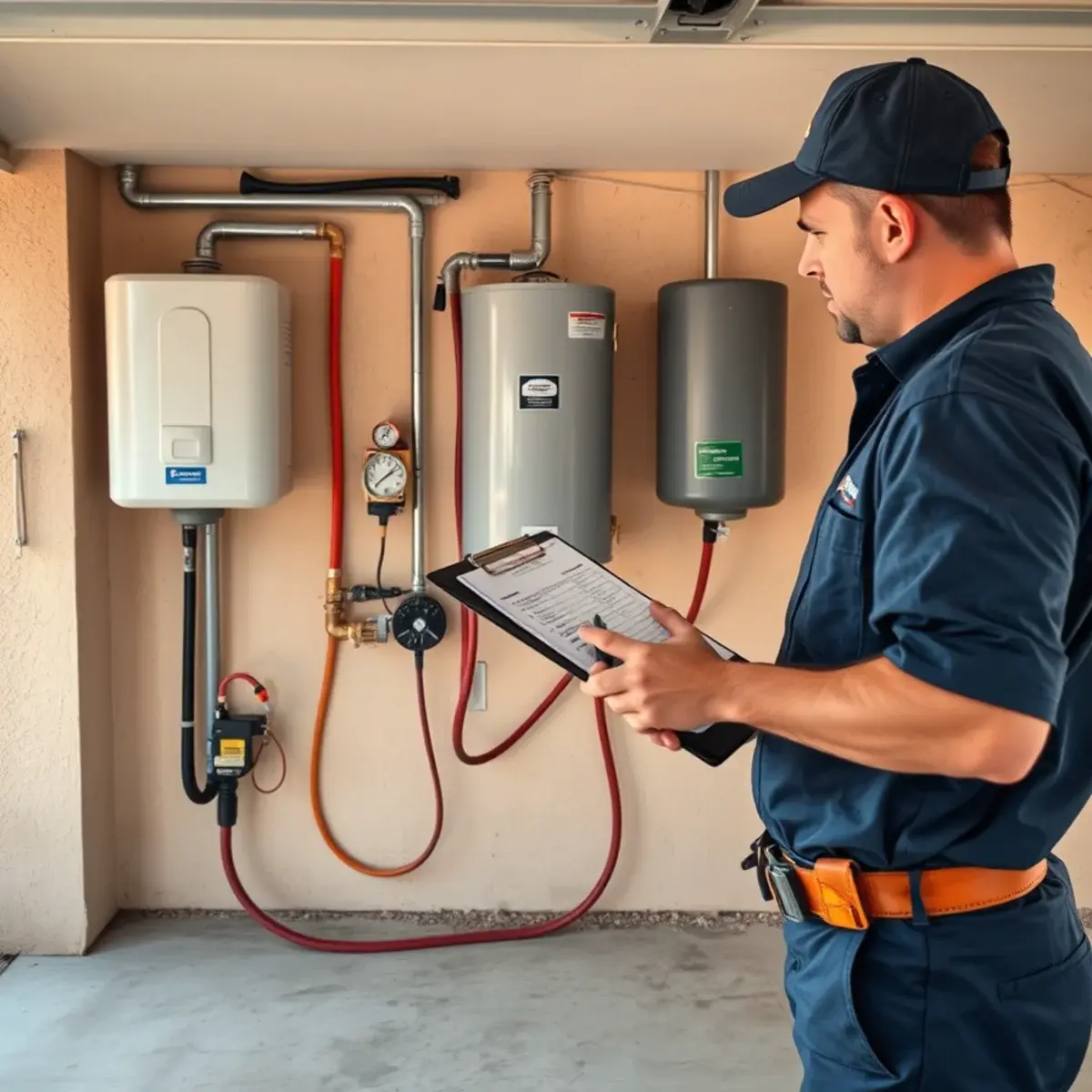
A garage water heater that fails on a storm night is the worst possible timing — you are competing with a full emergency queue. If yours is past year eight, get it inspected in the spring and make the replacement decision on your own schedule. See water heater service.
While you are at it, confirm the drain pan under it is actually piped to a drain. A pan with no outlet does nothing when a tank lets go.
7. Know your shutoffs

Main water shutoff, water heater cold inlet, irrigation valve, gas shutoff at the meter. Find them, confirm they turn, and show every adult in the house. Hard water seizes valves nobody operates — see how to find and shut off your main water valve.
Your monsoon season timeline at a glance
| When | What to do | Why then |
|---|---|---|
| May | Camera the main line, clear the cleanout, service the water heater, check drainage | Anything found can be fixed on a schedule at standard rates |
| Early June | Install a backwater valve if you have backed up before; confirm every shutoff turns | Permitted work needs lead time, and the season starts June 15 |
| June 15 – Sept 30 | Call early when drains misbehave; keep the cleanout accessible | Backups arrive in clusters after a cell, so the queue builds fast |
| During a storm | Stop all water use, keep people out of affected rooms, photograph before cleanup | Every gallon you send down adds to what comes back up |
| October | Re-camera if you had any backup; review what your policy actually covered | The cheapest time to fix what the season exposed |
8. Have the emergency number saved before you need it

During monsoon season we staff specifically for storm nights, because backups do not arrive one at a time. If a cell has just moved through and your drains are misbehaving, call early — the queue builds fast, and our proximity to the corridor only helps if we reach you before the list gets long. 24/7 emergency service reaches a real person at (614) 830-0578.
The full seasonal walkthrough is in the pre-monsoon plumbing checklist.
What surcharge actually means for your house
During a heavy cell over this corridor, the collection system takes on far more volume than a normal day. Where storm water reaches sanitary infrastructure the line surcharges — it fills to capacity and pressurises. Your lateral then has nowhere to discharge, and waste backs up toward the lowest opening in the house.
That is why a storm backup may indicate no defect at all on your property, and why we camera every one. If your lateral reads clear to the connection and the main is full, it is not your repair. Homeowners get sold jettings for this every August.
The permanent answer, honestly framed: a backwater valve stops the main pushing back into your home. It does nothing about roots or a belly on your own line. Both matter, they are different problems, and a camera inspection in May tells you which ones you actually have before you spend money on either.
The bottom line
Everything on this list is cheaper, easier to schedule and more effective in May than discovered in August at 10 PM during a storm. Camera the main, clear and mark the cleanout, check your insurance for a water backup endorsement, service the heater, and confirm every shutoff still turns. If your home has already backed up more than once, get a backwater valve quoted now — see emergency sewer backup service.
Frequently asked questions
May. That gives you time to address anything a camera inspection turns up before the season starts on June 15, and it keeps you out of the August emergency queue. It is also when scheduling is easiest — everyone else is calling in July.
It is a one-way check valve installed on your sewer lateral. Waste flows out, and when the main surcharges during a storm, a flapper closes and blocks it from flowing back into your home. If your house has backed up during more than one storm, it is the permanent fix — cleaning the line again will not change the outcome.
Because storm water can reach sanitary infrastructure and surcharge it — the line fills to capacity and pressurizes. Your lateral then has nowhere to discharge, so waste backs toward the lowest opening in your home. That is why a storm backup may not indicate any defect on your property at all.