Private Wells on San Tan Valley's Fringe: Testing & Treatment
A well is a system you own entirely, and treatment designed without a lab test is guessing with money. Here is what to test for and the correct order of treatment stages.
The short answer
Start with a laboratory test, not a softener. On a private well you should test at least annually for hardness, iron, manganese, hydrogen sulphide, total dissolved solids, nitrate, bacteria, pH and arsenic. The correct treatment sequence — sediment, then iron or sulphur, then softening, then point-of-use RO — depends entirely on what that panel finds.
On the semi-rural fringes of San Tan Valley — parts of Sun Valley Farms, Taylor Ranch, and out toward Chandler Heights — a meaningful number of properties are on private wells rather than municipal service.
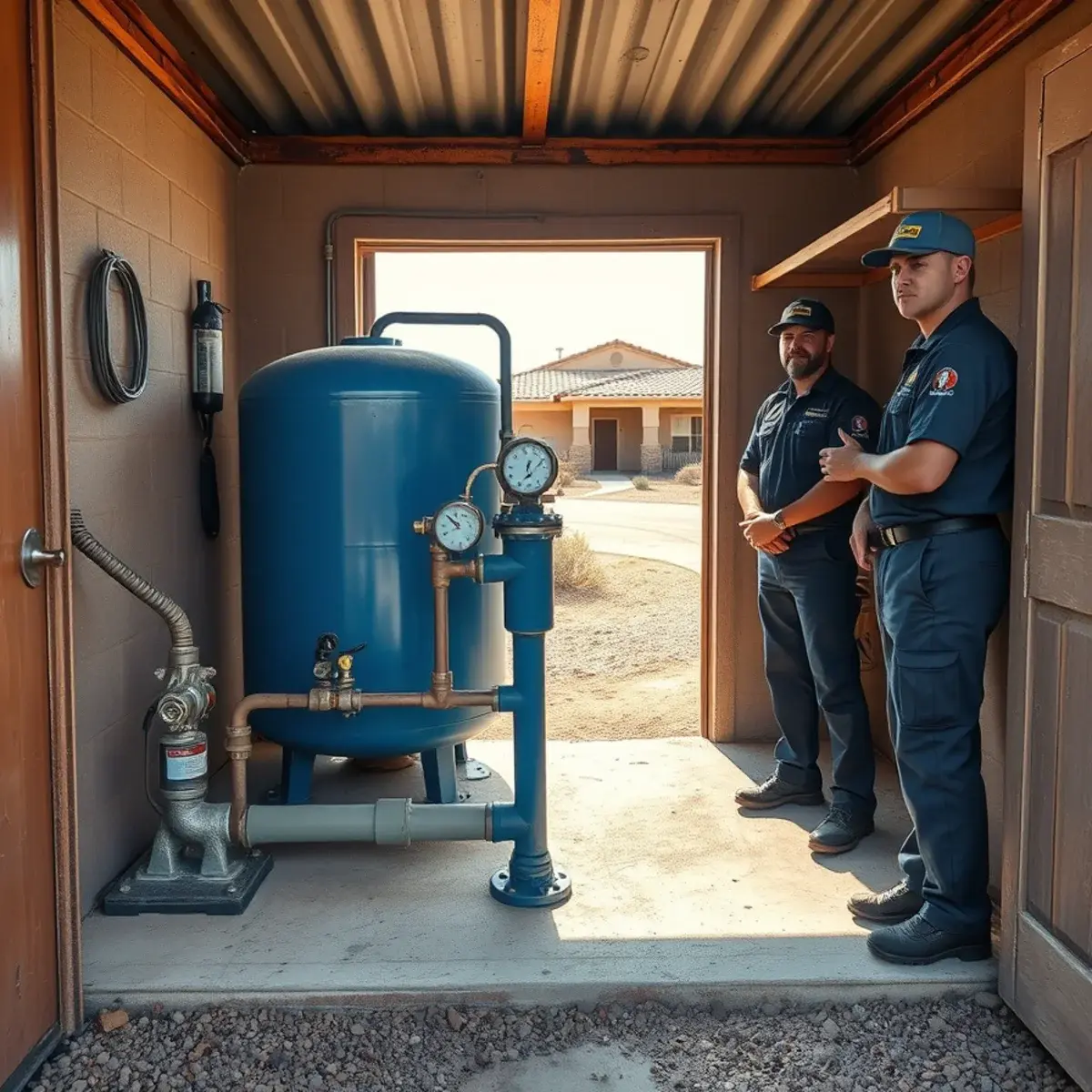
That changes everything. On a well you own the entire system: the pump, the pressure tank, the pressure switch, the piping and all of the treatment. Nobody is testing your water for you, and nobody is coming if it fails.
Start with a laboratory test, always
This is the single most common mistake we see: a well owner buys a softener because a salesperson recommended one, and it does not solve the complaint they actually had. Hardness is only one of several things that can be in Arizona groundwater.
A basic well panel should cover:
- Hardness — usually higher on a well than the 15–18 grains of municipal supply
- Iron and manganese — the cause of orange or black staining on fixtures and laundry
- Hydrogen sulfide — the rotten-egg smell, particularly noticeable in hot water
- Total dissolved solids — a general measure of mineral content
- Nitrate — genuinely important where there is agricultural activity nearby, and a health concern for infants
- Bacteria (total coliform and E. coli) — a basic safety screen
- pH — affects how corrosive the water is to your plumbing
- Arsenic — worth including in Arizona groundwater testing
Test annually at minimum, and additionally after any flooding, after well work, or if the taste, smell or appearance changes.
Treatment goes in a specific order
This is where design matters more than equipment. Stages go in sequence because each one protects the next, and getting the order wrong ruins expensive components.
| Stage | Purpose | Why the order matters |
|---|---|---|
| 1. Sediment filtration | Removes sand and particulate | Protects everything downstream from abrasion and fouling |
| 2. Iron / manganese treatment | Oxidizes and filters metals | Iron will foul a softener's resin bed if it reaches it |
| 3. Hydrogen sulfide treatment | Removes the sulfur odor | Often handled by the same media as iron |
| 4. Water softener | Removes hardness | Protects heater, fixtures and appliances |
| 5. Point-of-use RO | Drinking and cooking water | Handles dissolved solids, nitrate and taste at the tap |
Putting a softener in front of iron treatment is the classic error. Iron fouls resin, the softener stops performing, and the owner concludes softeners do not work. See water softener installation for how we approach system design.
The pressure system: where most well calls actually start
Most 'my well has low pressure' calls are not a water problem at all. They are a pressure tank problem.
A pressure tank holds an air charge that cushions the system and keeps the pump from starting every time you open a tap. When the tank loses that charge — becomes waterlogged — the pump cycles on and off rapidly, pressure surges and drops, and the pump wears out fast.
Other pressure system components worth knowing: the pressure switch, which tells the pump when to run and eventually fails; and the check valve, which keeps water from draining back down the well.
Long buried runs
Rural properties have distance between the well head, the house and any outbuildings. A leak in a buried line can run for months, showing only as a soft spot in the dirt or a pump that runs more than it should.
Locating those electronically rather than trenching the whole run is the difference between one excavation and a destroyed property. See emergency leak service.
A practical annual routine for well owners
- 1Lab test the water — full panel including bacteria and nitrate.
- 2Check the pressure tank's air charge and the pressure switch settings.
- 3Inspect and change sediment filters, and service any iron or sulfur media.
- 4Check softener salt level, brine tank condition and bypass operation.
- 5Replace RO membranes and filters on the manufacturer's schedule.
- 6Inspect the well head and cap for damage or intrusion, and confirm surface water drains away from it.
- 7Watch the pump's run pattern for any change — it is the earliest warning you get.
We service wells across the fringe communities and out through the rural areas of Pinal County. The approach is always the same: test first, design the treatment train around what the test says, and fix the pressure system before anyone talks about filtration.
The mistake that ruins expensive equipment
Putting a softener ahead of iron treatment. Iron fouls the resin bed, the softener stops performing within months, and the owner concludes softeners do not work on well water. We see this regularly on the semi-rural fringe, and it is always a sequencing error rather than an equipment failure.
The other thing that surprises well owners: most 'low pressure' calls out here are not a water problem at all. A pressure tank that has lost its air charge makes the pump cycle rapidly on and off, which produces surging pressure and destroys pumps. Recharging or replacing the tank is inexpensive; replacing a burned-out submersible is not.
So treat rapid cycling as the one urgent well symptom. If the pump kicks on and off every few seconds while a faucet runs, shut the fixture and call — the damage compounds every minute it continues, and that is the difference between a cheap fix and a well contractor pulling three hundred feet of drop pipe.
The bottom line
On a well you own the entire system — pump, tank, switch, piping and all the treatment — and nobody is testing your water but you. Build an annual routine: lab panel, pressure tank air charge, sediment filters, softener salt and bypass, RO membranes, and a look at the well head and cap. We service all of it across the fringe communities and out toward Chandler Heights.
Frequently asked questions
At least annually for a full panel including bacteria, nitrate, hardness, iron, manganese and arsenic. Also test after any flooding, after work is done on the well, or any time the taste, smell or appearance of the water changes. Nobody tests it for you.
Iron. It is common in Arizona groundwater and a standard softener alone will not reliably handle it above certain levels — worse, iron fouls softener resin, so putting a softener in front of iron treatment ruins the softener. The fix is an iron filtration stage ahead of the softener, sized from your test results.
Almost always a waterlogged pressure tank that has lost its air charge. Recharging or replacing it is inexpensive; ignoring it burns out the pump, which is a much larger bill. Treat rapid cycling as urgent — shut the fixture off and get it looked at.