
Service Problem-Solving7 min read
Sewer Camera Inspection: What It Actually Reveals
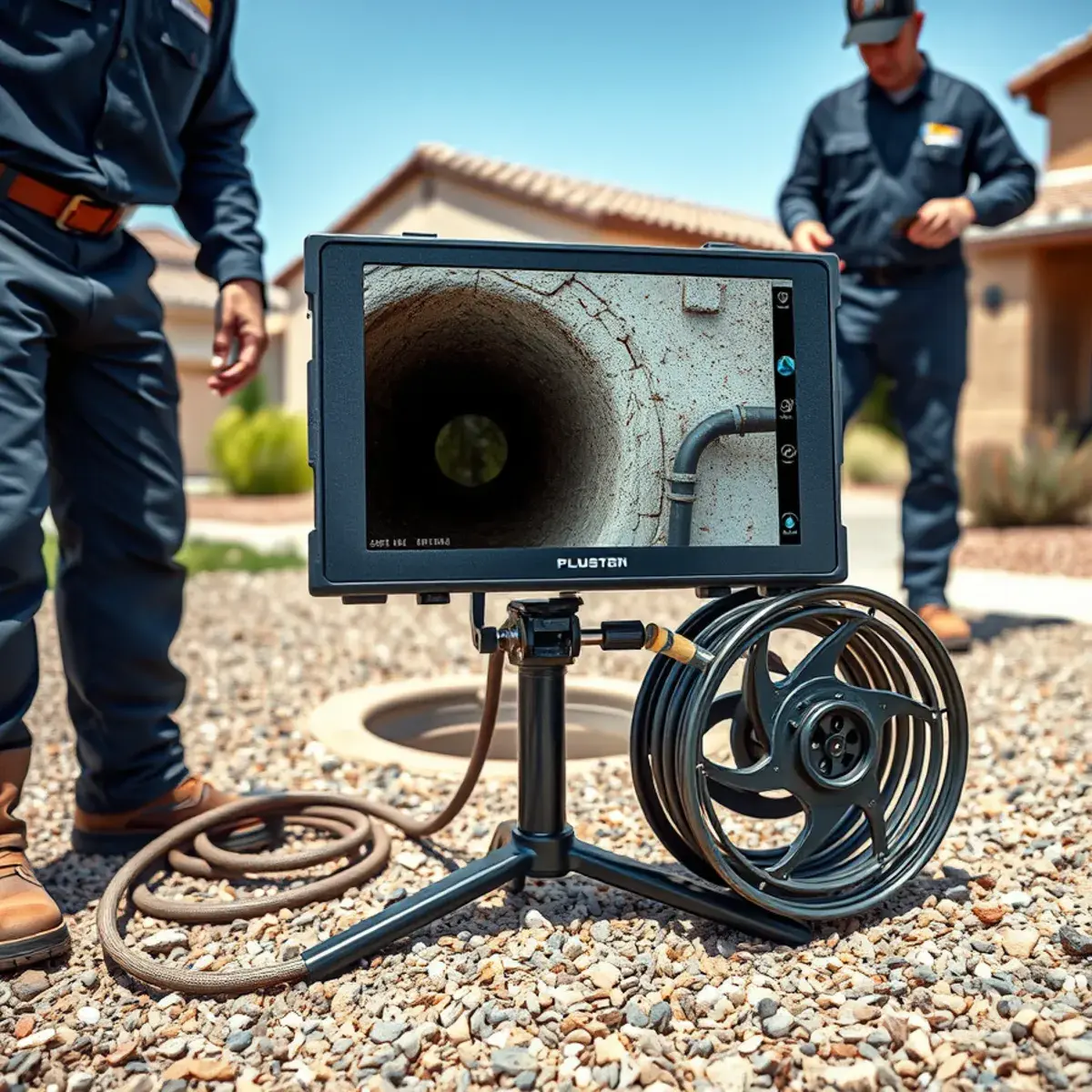
The difference between a $600 spot repair and a $9,000 replacement is almost entirely a diagnostic question. A camera is what answers it.
Read the guide24/7 emergency dispatch — a real person answers, day or night.
2769 E Combs Rd, San Tan Valley, AZ 85140
Plumbing service
4.9★
168 customer reviews
60–90 min
Typical San Tan Valley response
Licensed & insured
Bonded Arizona contractor
15–18 gpg
Hard-water specialists
Sewer Line Repair & Replacement in San Tan Valley
In San Tan Valley, laterals fail three ways. Roots find the joints in the mature neighborhoods where twenty years of mesquite and ash have gone looking for water. Bellies form where boom-era trenches were backfilled and compacted in a hurry, leaving a low spot that holds waste. And on the larger lots out toward Taylor Ranch and Bella Vista Farms, sheer length works against you — a hundred-foot run has more joints and less fall than a forty-foot run.
We diagnose with camera and locator, mark the defect on the ground with a depth reading, and then give you every option that genuinely applies to your pipe — including doing nothing yet, when that is the honest answer.

Signs you need us
Branch clogs affect one fixture. When the whole house slows down, the restriction is in the main or the lateral.
Guest shower pan, garage floor drain, or the tub in the hall bath. That is your main telling you it is blocked downstream. Stop running water and call our [emergency sewer backup line](/sewer-backup-emergency/).
Clearing every spring is a root signature — roots grow seasonally. Clearing every few months regardless of season points to a belly or an offset joint.
A leaking lateral irrigates and fertilizes the ground above it. On desert landscaping it shows up as a damp patch of gravel or a line of aggressive weeds.
A cracked lateral or a dry trap. We check the simple things first — you would be surprised how often it is a rarely used guest bathroom whose trap evaporated in August.
Long-term leakage undermines the soil around the lateral. It is uncommon but it is expensive when it is ignored.
What you get
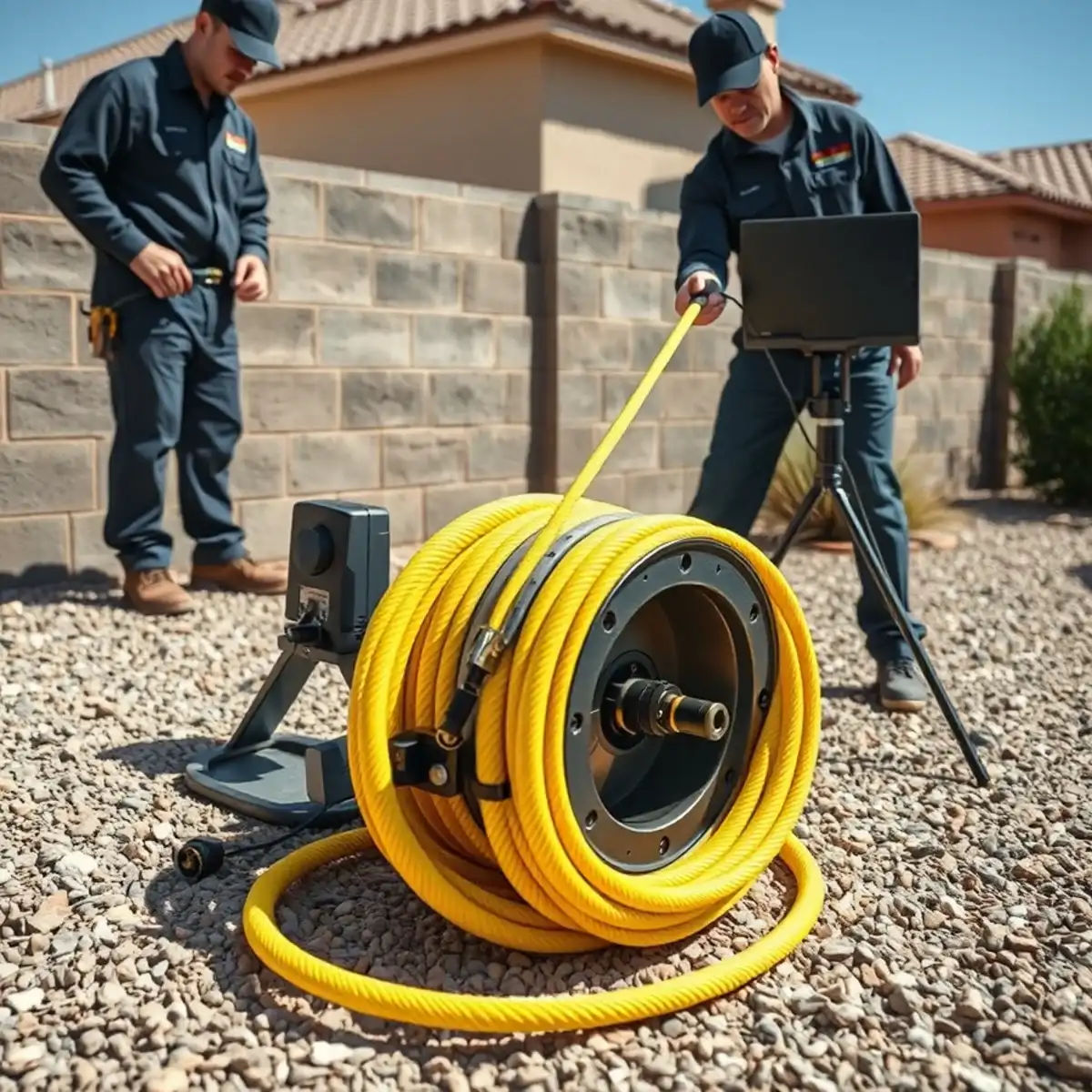
Before any quote, we run a self-leveling camera the length of the lateral from the cleanout to the tap, with a sonde in the head so we can locate any defect on the surface and give you a depth. You get the footage.
What we are reading for: root mass and where it is entering, offset or separated joints, cracks and fractures, bellies holding standing water, collapsed sections, foreign objects, and grease or scale accumulation. The difference between a $600 spot repair and a $9,000 replacement is almost entirely a diagnostic question, and the camera answers it. More on what the footage shows in sewer camera inspection: what it actually reveals.
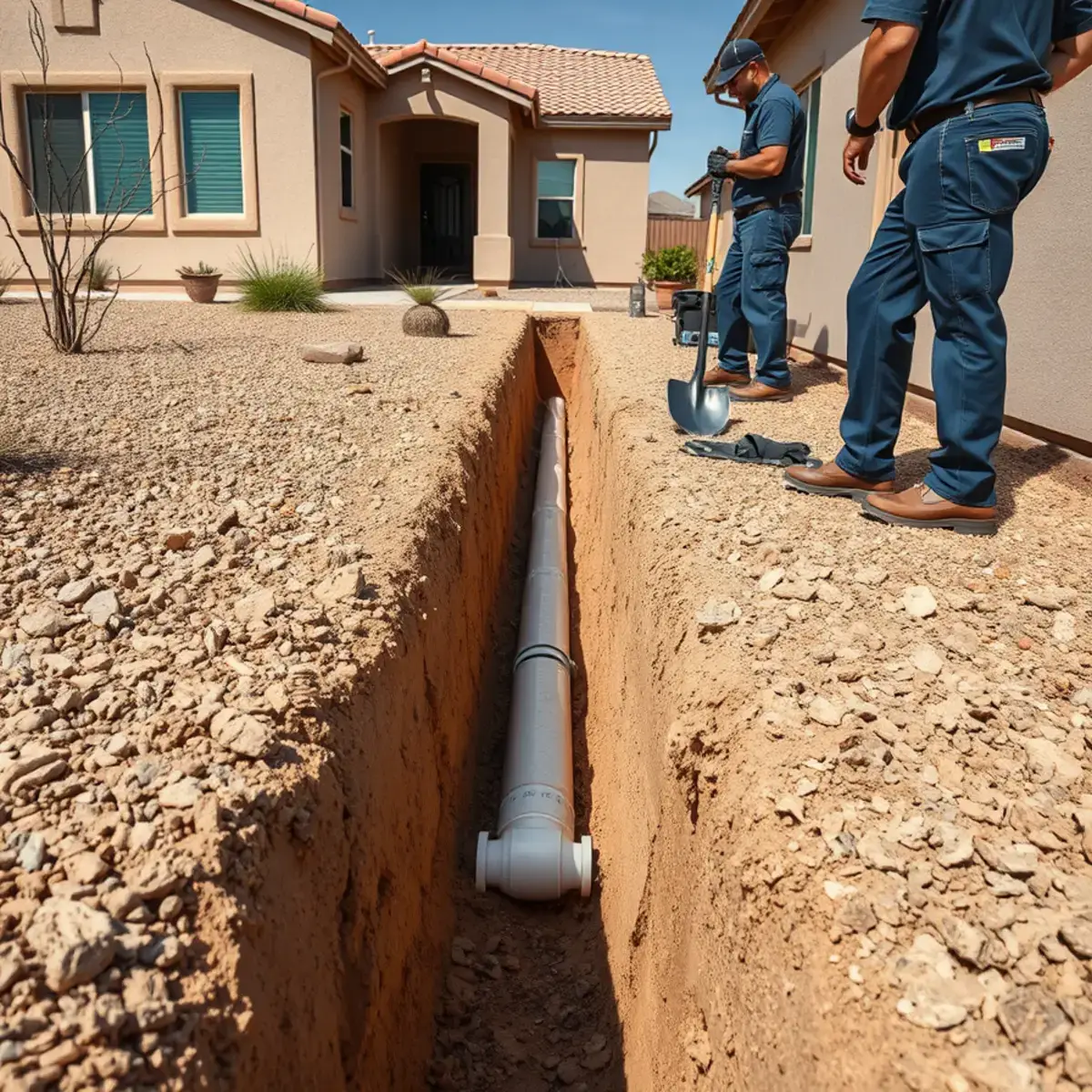
One bad joint, one crushed section, one root intrusion point. We excavate a short section, replace the damaged pipe, backfill and compact properly. Fastest and least expensive when the rest of the line reads clean on camera — and on most San Tan Valley properties the lateral runs under gravel landscaping rather than a driveway, which keeps restoration simple.
A resin-saturated liner is pulled into the existing pipe and cured in place, forming a new jointless pipe inside the old one. No trench across your yard. Excellent for root problems, because the liner seals every joint the roots were using. Requires a host pipe that is structurally continuous — it will not save a collapsed line — and it slightly reduces inner diameter, which is a non-issue on a four-inch residential lateral.
A bursting head is pulled through the old pipe, fracturing it outward while towing new HDPE behind it. Two small pits instead of a full trench. This is the trenchless answer when the existing pipe is collapsed or badly bellied and lining is not viable, and it lets us upsize the line if needed.
Sometimes it is simply the right call — a shallow line under gravel with a bad grade that needs to be re-laid at proper fall, or a lateral with multiple failures along its length. On many San Tan Valley lots with desert landscaping and no mature turf to destroy, open trench is both cheaper and better than the trenchless alternatives. We will not sell you a trenchless premium you do not need.
A sewer lateral works on gravity. Code wants roughly a quarter inch of fall per foot. Too little and solids sit; too much and water outruns the solids and leaves them behind.
During San Tan Valley's building boom, thousands of laterals were laid in trenches backfilled quickly in dry, expansive soil. Where compaction was rushed, the soil settled over the following years and took a section of pipe down with it. That is a belly, and it is why a fifteen-year-old home with no roots and no cracks can still clog twice a year. A camera shows standing water in the low spot on a line that should be empty — unmistakable once you have seen it.
Bellies cannot be cabled away. They can be lined only if the grade is still workable, and otherwise the section gets re-laid. Anyone who cables your belly every eight months and never mentions it is charging you rent on a defect.
Magma Ranch, Johnson Ranch and the mature streets around Bella Vista Road have the landscaping maturity to generate real root problems. Mesquite and ash send roots remarkable distances toward moisture, and the vapor escaping a slightly separated joint is a beacon.
Mechanical root cutting restores flow the same day. Lining or replacing the affected section ends it. We usually present both with real numbers, because for a homeowner planning to sell in two years, scheduled cutting is a defensible financial decision — and for someone staying twenty years, it clearly is not.
In most of San Tan Valley the homeowner owns the lateral from the house to the point of connection at the main — including the portion under the street or easement, in many cases. The utility owns the main. If the blockage is in the main, it is not your bill, and part of our diagnostic job is establishing which side of that line the problem is on before anyone starts digging. We have told plenty of homeowners to call the utility instead of paying us.
How we work
Full-length inspection from the cleanout, sonde locating any defect on the surface, depth marked and footage recorded for you.
If waste is backing up, we restore flow before anything else. A diagnosis can wait ninety minutes; sewage in your hallway cannot.
Spot repair, lining, bursting, open trench — priced, with the pros and cons of each for your specific line and your specific yard.
Blue Stake called before any dig. Permits pulled where required. Excavation kept as tight as the job allows.
New line tested and camera-verified at correct fall, trench backfilled in lifts and compacted so it does not settle into the next belly, surface restored, and final footage delivered with your invoice.
What it costs
A forty-foot lateral at three feet is a different job from a hundred-foot lateral at seven feet. Depth drives shoring, spoil handling and time far more than length does.
Gravel landscaping is inexpensive to restore. A concrete driveway, a paver patio, a block wall or mature landscaping adds real cost — and is usually the reason a trenchless method wins.
Spot repair is the least expensive. Lining and bursting cost more per foot but avoid restoration costs. Full open-trench replacement is the largest scope. The right one is set by the camera, not by preference.
Sewer work is permitted and inspected work. We include it, and we schedule the inspection rather than leaving it to you.
An active backup needs immediate clearing at emergency rates. Once flow is restored, the repair itself can almost always be scheduled during normal hours at normal pricing.
Why Economy Plumbers
Nobody can diagnose a buried pipe from the top of a cleanout. If another company quoted you a replacement without showing you a defect on a screen, get a second opinion — that is the most expensive assumption a homeowner can accept.
A lot of San Tan Valley lots are gravel-landscaped with a shallow lateral, and on those an open trench is faster, cheaper and just as good. We quote both and tell you which we would pick.
You own the lateral to the main; the utility owns the main. Part of our diagnosis is proving which side the problem is on — and we have told plenty of homeowners to call the utility instead of paying us.
Cutting restores flow; it does not close the entry point. We show you the intrusion on camera and give you both numbers — scheduled maintenance versus a repair that ends it.
Sewer work is permitted, inspected work. We pull it and meet the inspector so you are not taking a day off to do it.
Flat-rate pricing agreed before work starts, and we will tell you honestly if there is a cheaper answer.
Where this comes up most
Mature landscaping around Magma Ranch K-8 sends tree roots into older sewer laterals, producing recurring root-intrusion camera-and-jetting jobs.
Larger fringe lots mean longer underground supply runs from meter to house — hidden yard-line leaks show up as soggy desert landscaping and high bills.
Pinal County seat since 1875 with a National Historic District; pre-1995 housing makes polybutylene repipes and aging sewer laterals the core call driver.
Arizona's third-largest city with deep older housing stock; southeast Mesa and the Las Sendas edge need sewer-line replacements and repipes at real scale.
We serve San Tan Valley and the surrounding Pinal County area — see every area we cover.
Questions we get
A camera inspection is the only way to know for certain. If your line clears easily and stays clear for a year or more, it was a clog. If it clogs on a schedule, or the camera shows roots, an offset joint, a crack or standing water in a section that should drain, you have a pipe defect that cabling will never fix.
Yes — both cured-in-place lining and pipe bursting. That said, a lot of San Tan Valley lots are gravel landscaped with a relatively shallow lateral, and on those an open-trench repair is often faster, cheaper and just as good. We quote both and tell you honestly which one we would choose.
In most cases here the homeowner owns the lateral all the way to the connection at the utility main, including the portion in the right-of-way. The main itself belongs to the utility. Part of our diagnosis is establishing which side the problem is on — if it is theirs, we tell you to call them rather than selling you a repair.
A spot repair is usually a single day. A trenchless lining is one to two days including cure time. A full open-trench replacement on a typical San Tan Valley lot runs two to three days including backfill, compaction and surface restoration.
Roots rarely break sound pipe. They find an existing hairline crack or a slightly separated joint where moisture vapor escapes, work in through that opening, then expand and enlarge it. That is why cutting roots restores flow but does not solve the problem — the entry point is still there.
Related
Slow sinks, gurgling tubs and backed-up mains cleared with cable machines, hydro jetting and camera diagnosis — not guesswork.
Learn moreSewage in the house is a health emergency. We clear the main, camera the line and tell you whether the problem is yours or the utility's.
Learn moreHunt Highway retail, restaurants, offices, HOAs and rental portfolios — scheduled maintenance and after-hours response that keeps doors open.
Learn moreRecorded footage and a located depth, so nobody digs your yard on a guess.
Learn moreHigh-pressure jetting that scours the pipe back to bare wall, for drains that keep coming back.
Learn moreThe difference between a $600 spot repair and a $9,000 replacement is almost entirely a diagnostic question. A camera is what answers it.
Read the guide
Sewage in the house is a health emergency, not a plumbing inconvenience. Stop all water use first — and understand why the blockage may not be on your property at all.
Read the guideFree estimate
Call and a real person picks up — day, night, weekend or holiday. Most in-town calls see a truck in 60–90 minutes.