Water Heater Replacement Cost in San Tan Valley (2026 Guide)
Honest ranges, what drives them, and the code corrections that legitimately add cost. Plus why San Tan Valley tanks die years before the label says they should.
The short answer
Common water heater repairs in San Tan Valley run $150 to $500, with element replacement typically $150 to $250. Replacement is priced on tank size, fuel type, access and any code corrections the existing installation needs — a 40-gallon electric straight swap is the least expensive, a tankless conversion the most, and the gap between them is larger than most people expect.
Water heater pricing is where homeowners feel most in the dark, so let us be direct about what the numbers actually depend on. Everything below is a general market range for the San Tan Valley area — your written quote is the real number, and any company that gives you a firm price over the phone without knowing your setup is guessing.
Repair costs first
Most no-hot-water calls are repairs, not replacements. Common ones land in the $150 to $500 range depending on the part and the unit:
| Repair | Typical range | Notes |
|---|---|---|
| Electric heating element | $150 – $250 | The most common electric repair. Same-day. |
| Thermostat (electric) | $150 – $300 | Often paired with an element replacement. |
| Thermocouple (gas) | $150 – $300 | Classic 'pilot lights then dies' fix. |
| Gas control valve | $300 – $500+ | The priciest common part. On an older tank, weigh against replacement. |
| T&P relief valve | $150 – $275 | Often accompanied by an expansion tank issue. |
| Expansion tank | $200 – $400 | Fixes the weeping relief valve most people misdiagnose. |
| Tank flush and inspection | $100 – $200 | The best money you will spend on a water heater in this town. |
Replacement costs
A replacement is priced on the unit, the labor, and any code corrections the existing installation needs. Broadly:
- 40–50 gallon electric, straight swap — the least expensive replacement we do.
- 40–50 gallon gas, straight swap — modestly higher; gas units cost more and venting adds work.
- 65–75 gallon gas — larger unit, more labor, sometimes venting changes.
- Tankless conversion — the largest number by a wide margin, and for real reasons (below).
What legitimately adds cost
Code corrections on an old install
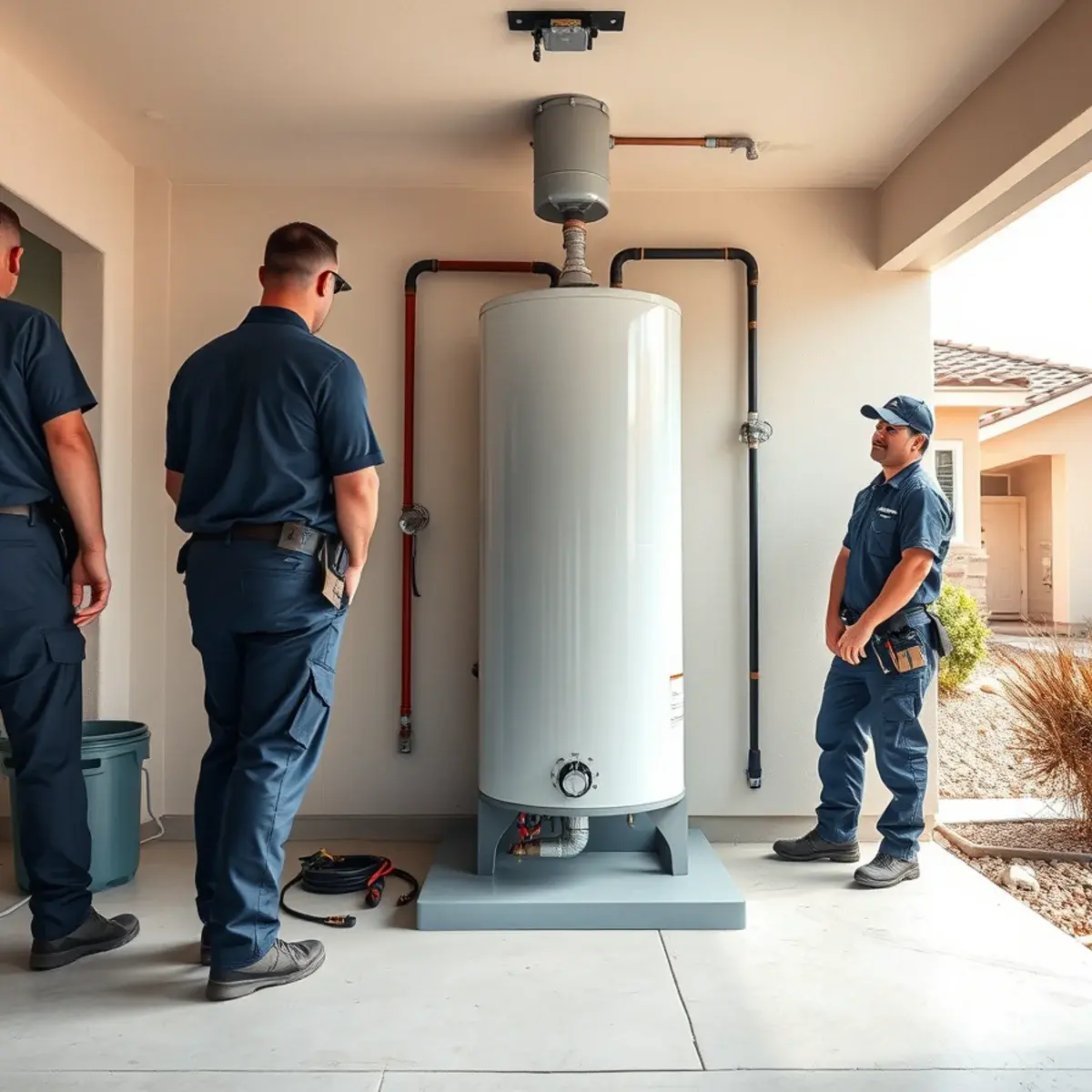
These are the items that surprise homeowners, and they are not padding. If the existing T&P discharge line is illegal, if there is no thermal expansion tank on a closed system, if the venting is wrong or the drain pan has no outlet — correcting those is part of a legitimate installation. We photograph what we find and explain why each one is required before adding it to the quote.
Access and location
A garage install on a flat slab with clear access is the straightforward case, and that describes most San Tan Valley homes. An interior closet, an attic platform, or a unit boxed in behind a water softener and shelving takes longer and sometimes takes two techs.
Upsizing
Going from a 40 to a 50 or 75 gallon unit may require different venting, different connections and sometimes physical modification of the space. Worth doing when the household has outgrown the tank, but it is not a like-for-like swap.
The tankless reality
A whole-home tankless draws roughly four times the fuel of the tank it replaces — often 150,000 to 199,000 BTU against 40,000. That almost always means upsizing the gas line, plus a dedicated vent penetration and a condensate path. Occasionally it means a meter upgrade from the utility.
Anyone quoting a tankless conversion at swap prices has not looked at your gas line. See gas line services and our tankless versus tank comparison.
Why San Tan Valley tanks die early
This is the part that affects your total cost of ownership far more than the install price. Manufacturers rate a standard tank at eight to twelve years. The honest local range is six to ten, and we see neglected units fail at five.
Two reasons. First, EPCOR's San Tan district delivers water at 15 to 18 grains per gallon, so sediment accumulates continuously on the tank floor — insulating the burner from the water, cutting effective capacity, and superheating the tank bottom until the glass lining fails. Second, most tanks live in a garage that exceeds 110 degrees for four months a year.
Repair or replace: the framework
| Situation | Recommendation |
|---|---|
| Under 6 years, tank sound, one failed part | Repair |
| 6–9 years, never flushed, second repair in 18 months | Usually replace |
| Any age, rust in hot water or a weeping seam | Replace — not a judgment call |
| 10+ years, working fine | Plan the replacement on your schedule |
| Household outgrew the tank | Replace and upsize, or evaluate tankless |
Questions to ask any quote
- 1Does this include a new expansion tank, and is my system closed?
- 2Does it include new shutoff and flex connectors, or are the old ones being reused?
- 3Is the T&P discharge line being brought to code, and where does it terminate?
- 4Is a permit being pulled, and is the fee included?
- 5Is haul-away of the old unit included?
- 6What is the labor warranty, and what is the manufacturer's tank and parts warranty?
A quote that is meaningfully cheaper than the others usually differs on one of those six lines. Ask which one.
We install throughout San Tan Valley and are in Johnson Ranch constantly — its late-1990s phases have the oldest tract homes in town, which means a lot of tanks reaching the end of their second generation. Full details on our water heater service.
The line item that explains a suspiciously cheap quote
When one water heater quote comes in well under the others, it is almost always missing the same things: a thermal expansion tank, a code-compliant temperature and pressure relief discharge line, new shutoff and flex connectors rather than reusing the corroded originals, and the permit. None of those are visible once the unit is standing there, which is exactly why they get dropped.
The expansion tank is the one that costs you later. Arizona homes on a closed system — anything with a pressure-reducing valve or a check valve — need somewhere for heated water to expand. Without it the relief valve weeps after every cycle, and the homeowner is told a year later that the new tank is failing.
The honest tradeoff nobody mentions: the install price matters far less than the maintenance. A softened, annually flushed tank routinely outlives an unsoftened neglected one by four or five years in this water. Spread across the equipment life that is a bigger saving than shopping three quotes.
The bottom line
Ask any quote six questions: is an expansion tank included, are the shutoff and flex lines new, is the T&P discharge being brought to code, is a permit pulled, is haul-away included, and what is the labour warranty. A quote that is meaningfully cheaper usually differs on one of those six lines. Our water heater repair and installation page sets out exactly what we include.
Frequently asked questions
It depends on size, fuel type, access and what code corrections the existing installation needs. A 40 to 50 gallon electric straight swap is the least expensive; a large gas unit or a tankless conversion is substantially more. We give a firm written number after seeing the setup — a phone quote without seeing it is a guess.
Usually not, if it has never been flushed and this is not the first repair. You would be paying for parts on a tank whose lining has been cooking under a sediment bed for years, and the next failure is often the tank itself. If it has been maintained and this is a first failure, repair can make sense.
Hard water at 15 to 18 grains per gallon deposits sediment continuously in the tank, and most tanks sit in garages that exceed 110 degrees in summer. Together those push real service life to roughly six to ten years against a label rating of eight to twelve. Annual flushing and a softener push you back toward the top of the range.